A Beacon of Progress in Trauma and Emergency Care.
From August 7th to 8th, 2025, Makerere University School of Public Health hosted the Second East African Symposium & Expo on Trauma, Injuries, and Emergency Care under the theme, “Understanding the burden and impact of injuries in East Africa to improve Emergency Care preparedness, mitigation, and response.
The event convened a dynamic assembly of researchers, healthcare professionals, policymakers, and innovators, sparking collaboration and knowledge exchange across the emergency care practitioners.
Uganda’s urgent need for robust emergency care systems is underscored by recent statistics:
In 2023, nearly 134,000 emergency cases were recorded with 17% attributed to trauma and injuries, and over 4,000 deaths linked to road traffic incidents.
Road traffic injury (RTI) deaths sit at an alarming 27.4 per 100,000 people annually, well above the global average of 17.4. Particularly concentrated in the Greater Kampala Metropolitan Area.
These figures highlight the heavy toll of trauma, especially from road traffic injuries, on families, livelihoods, and the national health budget. There is a severe need for effective emergency interventions.
The symposium was graced by an inspiring keynote address on Trauma, Injury, and Disability delivered by Dr. Milton Mutto, whose insights set the stage for robust dialogue on the intersection of public health, emergency care, and prevention. The Guest of Honour, Dr. Diana Atwiine, Permanent Secretary of the Ministry of Health, delivered a heartfelt and rousing speech urging all stakeholders to adopt a multi-sectoral approach to reducing the devastating toll of road traffic injuries in Uganda. She emphasized that effective emergency care is critical to reducing mortality and disability from injuries and challenged academia to “move beyond the walls of comfort” into the community where change is most needed.
Reflecting on the country’s high road traffic injury burden, Dr. Atwiine called for coordinated action across ministries and agencies citing the urgent need for sidewalks, wider roads with ambulance lanes, strict enforcement of traffic and road safety regulations, improved driver testing, and better road user behavior. She also underscored the role of research in driving policy reform, urging universities to produce actionable evidence that can inform national strategies. Her address not only energized the audience but also reinforced the symposium’s role as a catalyst for collaboration, innovation, and policy engagement.
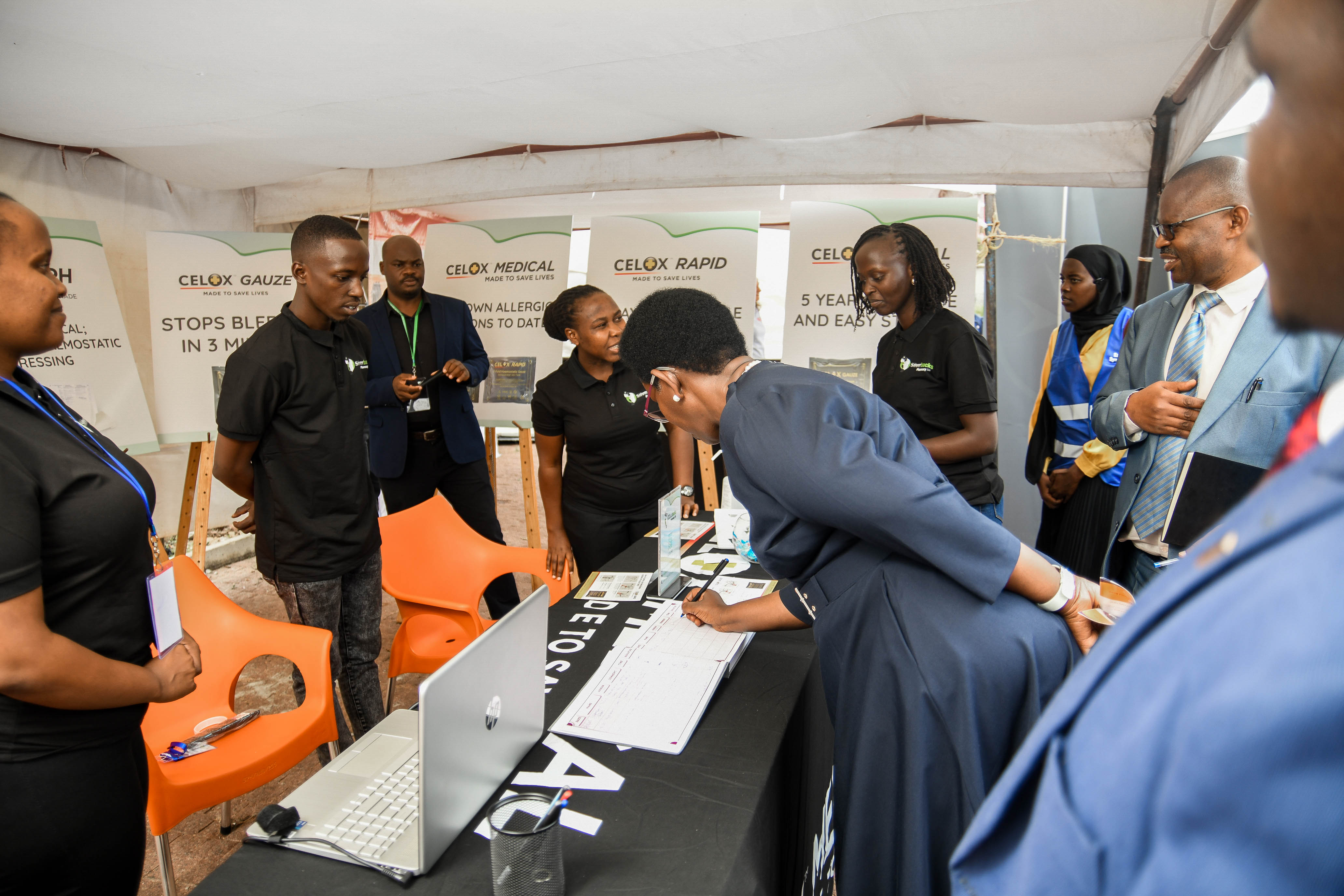
At the symposium, Uganda marked the launch of Celox Gauze and Celox Rapid, advanced hemostatic dressings engineered to swiftly stop life-threatening bleeding. These products are a life -saving game changer in emergency care.
What Makes Celox So Powerful?
Celox Gauze - Backed by meta-analytic evidence, this chitosan-based dressing significantly improves survival in traumatic injuries and dramatically reduces blood loss compared to traditional methods. This gauze stops bleeding in three minutes of compression.
Celox Rapid - Real-world post-market data reveals a 100% first-application hemostasis success rate (84 out of 84 cases), even among patients with the most severe bleeding or on anticoagulants. All responders rated it “good” or “excellent,” with no adverse events reported. This gauze stops bleeding in 60 seconds of compression.
Together, these innovations offer frontline responders, and facilities from rural health centers to major hospitals, a proven means to stop hemorrhage quickly and effectively saving lives.
Uganda’s emergency medicine sector has seen remarkable strides. Emergency Medicine (EM) residency programs launched at Mbarara University (2017) and Makerere University (2018) are graduating a new cadre of specialists.
The Second East African Symposium on Trauma, Injuries and Emergency Care is a beacon of light on East Africa’s road ahead in trauma and emergency care. With current data painting an unfortunate portrait of Uganda’s emergency burden, the country stands poised for transformational progress. If widely adopted, medical technology could radically improve survival rates, elevate pre-hospital and facility-based trauma response, and propel Uganda toward a safer, more resilient future